

Subproject 3 | University of British Columbia
Learning in the System

Developing education for present and future chemical risk management professionals
'Learning in the System' is one of six sub-projects in All Our Chemical Relations.
The aim is to help present and future chemicals management professionals engage respectfully with Indigenous Peoples and their knowledge systems by developing education specifically designed to meet the needs of our three target audiences.

Learning in the system
Government
In collaboration with staff at Health Canada (HC) and Environment and Climate Change Canada (ECCC), we work alongside Indigenous educators, researchers, and community members to iteratively develop learning materials for government staff involved in chemical risk assessment and chemicals management.
Academia

In this learning spiral, we iteratively develop case-based educational toolkits to help researchers and students grapple with, and better navigate the ethical challenges they face when conducting research with or about Indigenous Peoples and their lands.
Community

Many Indigenous communities employ or consult professionals from outside the community to help with work related to chemicals management. In this learning spiral, we iteratively develop materials for such professionals to help them work in ways that better serve the communities they support.
In Canada, as in most countries in the world, the government determines what kinds of chemicals are allowed in what types of products and for what purposes. The government also monitors the presence of chemicals in the environment with the aim of ensuring that it is safe/not harmful.
Government professionals do not do this work alone: Industry collects most of the data used for formal chemical risk evaluation. Some Indigenous communities have their own monitoring programs, and some NGOs contribute to the collection and interpretation of data. The chemicals management landscape is thus shaped by government professionals alongside those in the (petro-)chemical industry, Indigenous communities, and NGOs. University researchers also contribute, as do students, who after graduation may be hired as professionals by an Indigenous community, government, industry, or NGO.
Canadian law requires government staff to engage with Indigenous Peoples and to include Indigenous Knowledge and expertise when they carry out work related to chemical risk assessment and chemicals management. Public servants do, however, often lack the training to engage with Indigenous Peoples in a way that respects Indigenous ways of knowing and their right to self-determination and sovereignty. This is also true for industry employees, researchers and students who do work of relevance to chemicals management. It may also be also true for professionals who are hired by Indigenous communities to help them with issues related to chemicals management of relevance to their communities.
‘The system’ refers to the formalized system surrounding chemicals risk assessment and chemicals management.
It is increasingly recognized that the lack of knowledge of how to respectfully engage with Indigenous Peoples can be directly harmful, despite good intentions. Our goal is to contribute to a better future for all by developing learning material specifically designed to meet the needs of our three target audiences.


Academia
Chemical risk assessment and management relies heavily on research, and most chemical risk management professionals have a university degree. Academia does, however, have a bad reputation among Indigenous Peoples because studies have historically been done without any consideration of their interests, needs, or rights. Many studies have, in fact, been harmful and conducted without free, prior, and informed consent. Various Indigenous communities began developing ethical guidelines in the 1970s, but Canadian universities were slow to follow suit.
We recognize that awareness and knowledge are increasing in academia, with a rising number of undergraduate and graduate programs requiring students to familiarize themselves with Indigenous-led ethical guidelines such as OCAP® (First Nations' principles of ownership, control, access, and possession), and Chapter 9 in the 2022 revision of the Tri-Council’s ethical guidelines (TCPS2) deals specifically with such ethical challenges. Even so, broadly speaking, many still do not understand what it means to implement these principles in practice, which far too often leads to well-intentioned but harmful and extractive studies.
Contact Info:
Prama Roy (prama.roy@ubc.ca)
Gunilla Öberg (gunilla.oberg@ubc.ca)

Community
Many Indigenous communities employ or consult professionals from outside the community to help with work related to chemicals management. In this learning spiral, we aim to iteratively develop material for such professionals, to help them work in ways that better serve the community they work for.
Contact Info:
Gunilla Öberg (gunilla.oberg@ubc.ca)
Niiyokamigaabaw Deondre A. Smiles (deondre.smiles@bemidjistate.edu)
Sue Chiblow (schiblow@uoguelph.ca)

Government
Canadian law requires government staff to engage with Indigenous Peoples and to include Indigenous Knowledge and expertise when carrying out work related to chemical risk assessment and chemicals management. A central problem is the way in which engagement and consultation are understood and implemented.
In this learning spiral, we develop learning materials designed to strengthen government staff's ability to engage with Indigenous Knowledge and expertise in ways that respectfully and meaningfully include Indigenous Peoples' priorities and their right to self-determination and sovereignty. This requires engagement to happen at the beginning of processes, not the end — a shift from how engagement is typically done.
Contact Info:
Dayna Rachkowski (drachkow@student.ubc.ca)
Kimani Karangu (karangu@mail.ubc.ca)
Maggie Devins-Cann (maggie.devinscann@ubc.ca)
Gunilla Öberg (gunilla.oberg@ubc.ca)

The Spiral
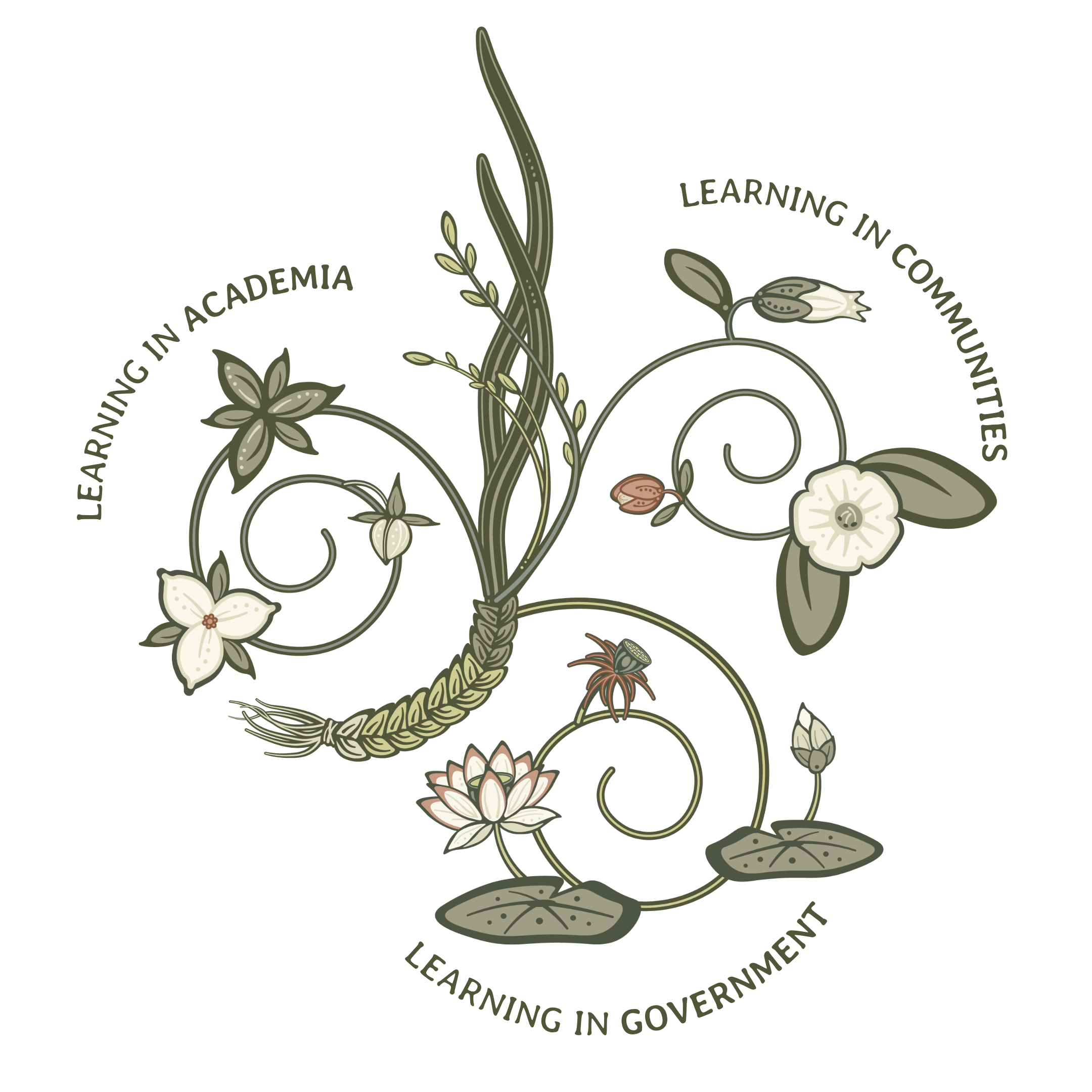
We have selected the spiral as a symbol of our work to reflect the iterative nature of our process: we identify learning needs and design learning material based on conversations with, on the one hand, Indigenous scholars and Elders engaged in All Our Chemical Relations, and, on the other hand, collaborators from our target audiences. We develop drafts, bring them back for feedback, and repeat. We position ourselves as learners throughout this entire process.
Mother Spiral

Sweetgrass in Anishinaabe floriography represents respect, reciprocity and relationship. The three strands of the braid usually symbolize the People, Land and Knowledge. This aligns well with collaborative environmental work and also overlaps with some of the other spirals which can be a unifying feature on each spiral.
Education of Future Chemicals Management Professionals

Trillium represents new beginnings and learning. Its three petal structure can represent balance or triads (i.e. knowledge, responsibility, action) and in this case: science, responsibility and protection of the environment.
Professionals Working for/with Nations
Tobacco Flower symbolizing respectful exchange and consent.
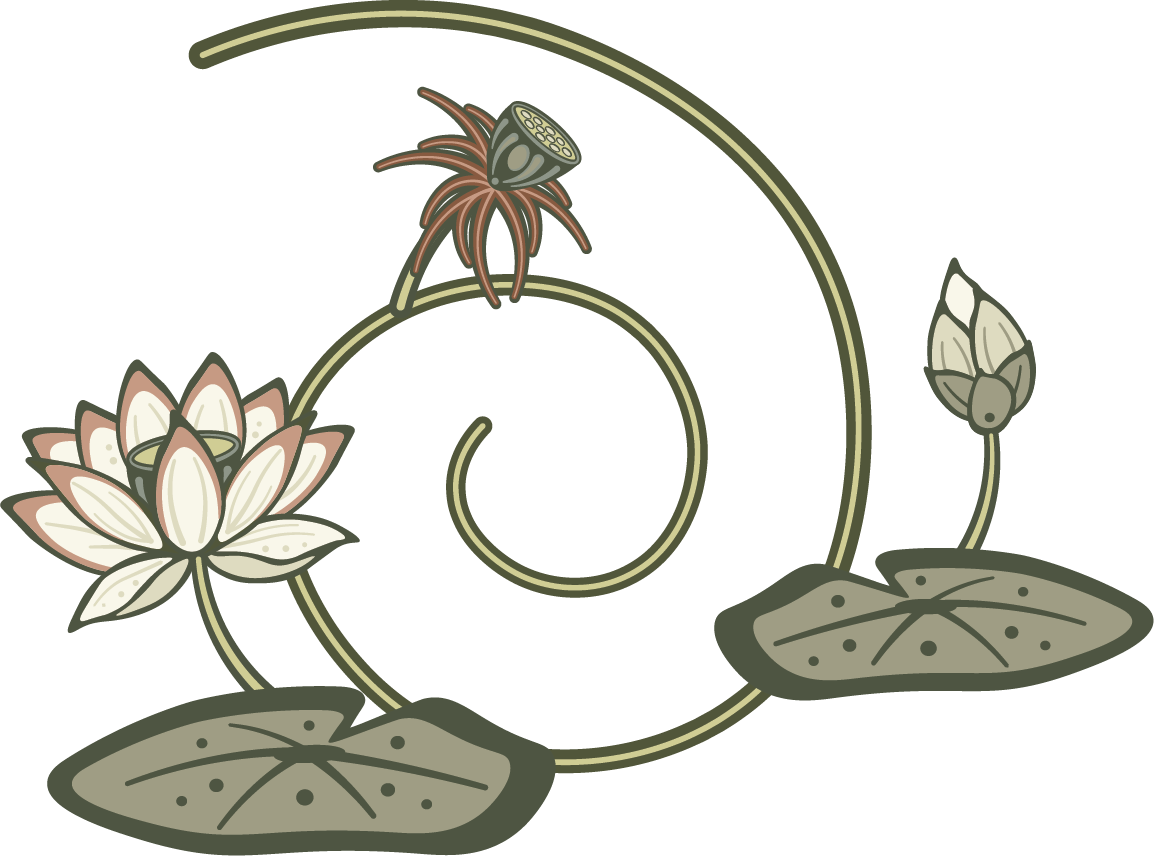
Government Officials Responsible for Chemical Regulation
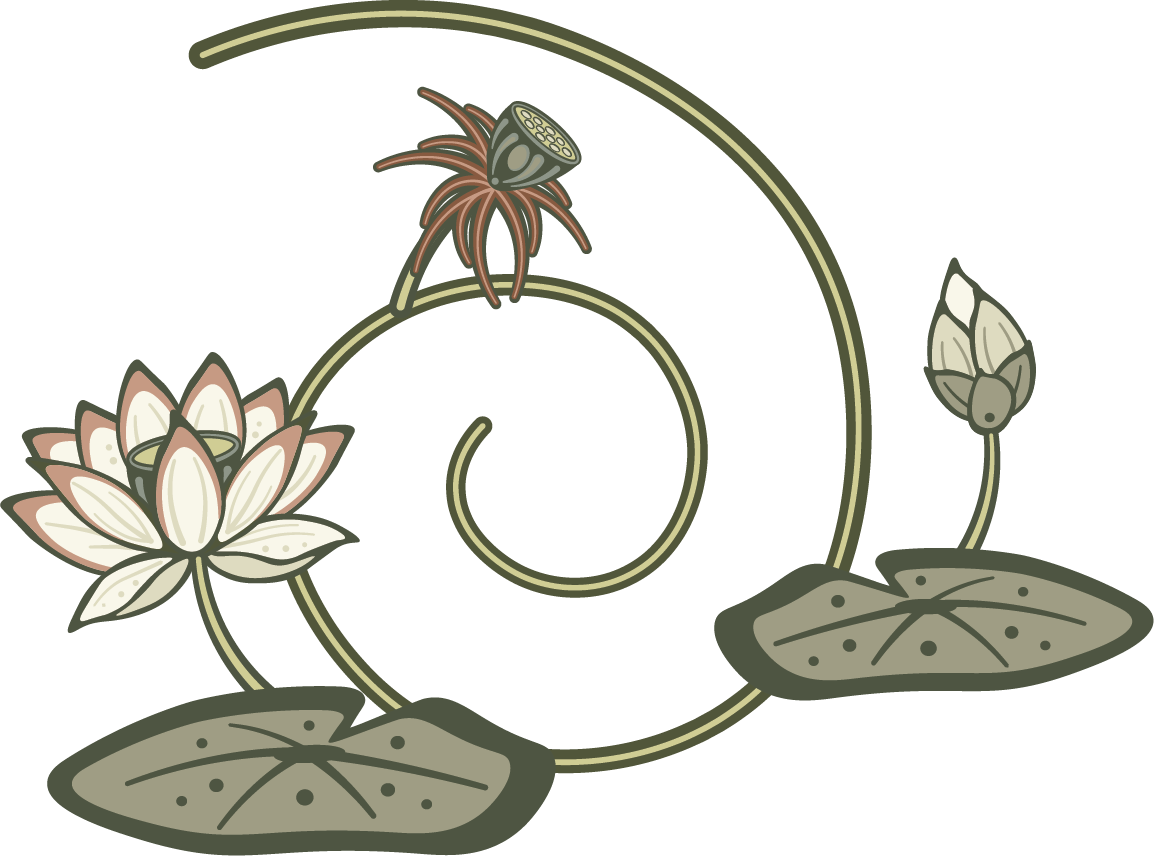
North American Lily/Lotus in floriography represents knowledge emerging from difficult environments/muddy waters.